
Expert insights from Dr. Akhilesh Kumar, leading Brain Surgeon in Lucknow
Most articles on brain tumor surgery give you the basics: what it is, how it’s done, and recovery time. They’re useful, but they don’t tell the full story.
They rarely answer the real questions: When should you avoid surgery? What if complete removal isn’t possible? What about long-term effects on memory and thinking?
This guide digs deeper. It’s not dramatic or overly reassuring. It’s honest, practical advice from Dr. Akhilesh Kumar, an experienced Brain Surgeon in Lucknow who has guided countless patients through these difficult decisions.
Understanding Brain Tumor Surgery
Let’s be clear: surgery is rarely the end of your treatment journey. It’s usually the first step in a longer management plan.
Brain tumor surgery isn’t one single procedure. It can be:
- Biopsy – Taking a small sample to identify the tumor
- Debulking – Removing part of the tumor to reduce pressure
- Complete resection – Attempting to remove the entire tumor
- Awake surgery – Operating while you’re awake to protect speech and movement
- Minimally invasive surgery – Using small incisions and cameras
- Shunt placement – Draining excess fluid
- Palliative surgery – Relieving symptoms when cure isn’t possible
Each approach has a different goal. And the goal determines what success looks like.
Your Surgical Journey: What to Expect
Step 1: Getting an Accurate Diagnosis
Brain Tumor Surgery in Lucknow starts with detailed imaging:
- MRI with contrast dye
- Functional MRI (shows active brain areas)
- DTI tractography (maps nerve pathways)
Here’s what matters: Scans show us where the tumor is, but not always how it will behave. The tumor’s genetic makeup often matters more than its size. This information helps Dr. Akhilesh Kumar decide how aggressively to operate.
Step 2: Planning Your Surgery
For complex cases, your care involves:
- Team meetings with multiple specialists
- Detailed scan reviews
- Cancer specialist input
- Anesthesia safety assessment
- Function risk mapping
The truth: Sometimes a tumor sits near your speech area. Removing 100% might leave you unable to speak. Removing 85% might preserve your speech. Which is better? This is where families face tough choices—because “complete removal” sounds better than “safe removal,” even when it isn’t.
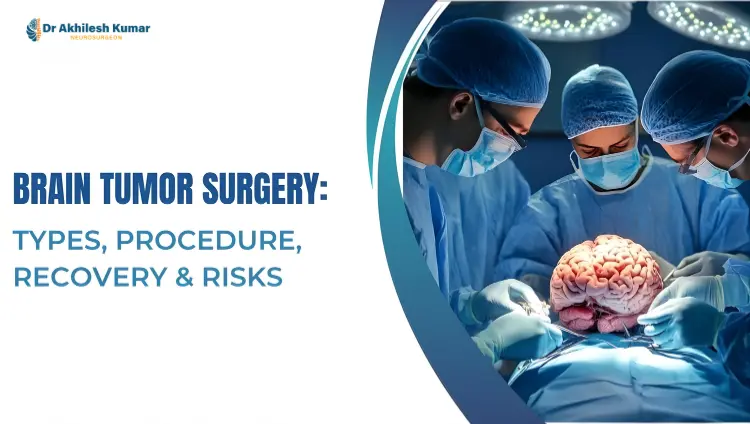
Step 3: In the Operating Room
During Brain Tumor Surgery in Lucknow, Dr. Akhilesh Kumar uses:
- GPS-like navigation systems
- High-powered microscopes
- Real-time brain function monitoring
- Immediate tissue testing
What you should know: Tumor edges often blend into healthy brain tissue. There’s no clear line. Every moment requires a decision: Remove more tissue or protect function? Experience matters here.
Step 4: Recovery Begins
After surgery, you’ll be monitored closely for:
- Brain swelling
- Bleeding
- Seizures
- Stroke symptoms
- Fluid leaks
The reality: Some patients feel worse on day 3 or 4 due to swelling. Some improve quickly. Some take longer. Recovery doesn’t follow a straight line.
Brain Tumor Surgery vs. Stroke Treatment: Key Differences
| What’s Different | Brain Tumor Surgery | Stroke Treatment in Lucknow |
|---|---|---|
| When it happens | Scheduled and planned | Emergency (minutes matter) |
| Main goal | Remove or reduce the tumor | Restore blood flow or stop bleeding |
| Recovery | Gradually over weeks to months | Fast at first, then gradually |
| Follow-up care | Regular scans to watch for tumor return | Focus on rehab and preventing another stroke |
| Key factors | Tumor type, location, and genetics | Type of stroke and how fast treatment starts |
Both require expert neurosurgical care. Dr. Akhilesh Kumar provides specialized treatment for both conditions in Lucknow.
What Determines Your Outcome?
| Factor | How It Affects Results | What You Need to Know |
|---|---|---|
| Where the tumor is | Critical areas (movement, speech, brainstem) are riskier | Sometimes leaving some tumor is safer—that’s smart, not failure |
| Tumor genetics | Certain mutations affect how well treatment works | Biology matters more than size |
| How much is removed | More isn’t always better | Safety comes before completeness |
| Your age and health | Affects healing and risk | Each person needs a personalized plan |
| Surgeon’s experience | More cases means better outcomes | Choose an experienced Brain Surgeon in Lucknow |
What Other Guides Don’t Tell You
Surgery Always Affects the Brain
Every brain operation involves:
- Moving brain tissue
- Applying gentle pressure
- Affecting tiny blood vessels
Even successful surgery can cause subtle changes in thinking, memory, or personality. Families often notice these changes, even if they’re not in the medical reports.
Complete Removal Often Isn’t Possible
Some tumors spread beyond what scans can see. So when you ask, “Did you get it all?” the honest answer might be: “Yes, we removed everything visible on the scan. But microscopic cells may remain.”
This affects when and if the tumor might come back.
Planning for the Long Term Matters Most
Important questions rarely asked:
- Can you operate again if needed?
- Will scar tissue make future surgery harder?
- Should we do radiation before the tumor returns?
- Are we protecting pathways for future treatment?
With Dr. Akhilesh Kumar’s approach to Brain Tumor Surgery in Lucknow, you’re not just planning one operation—you’re planning a long-term strategy.
How Modern Genetics Changes Surgery
| Genetic Test | What It Reveals | How It Changes Surgery |
|---|---|---|
| IDH Mutation | Slower-growing, better outlook | May allow less aggressive first surgery |
| MGMT Methylation | Responds better to chemotherapy | Affects timing of surgery vs. other treatments |
| 1p/19q Co-deletion | Specific tumor type, responds well to treatment | Guides how aggressively to operate |
Operating aggressively on an aggressive tumor doesn’t always extend survival, but it might reduce quality of life. Genetic testing helps guide the right approach.
Long-Term Effects on Thinking and Memory
Even benign (non-cancerous) tumors can cause:
- Difficulty with planning and decision-making
- Memory problems
- Personality changes
- Ongoing fatigue
Why? Surgery affects brain networks, not just tissue. Healing isn’t just about the wound closing—your brain has to rewire and adapt.
Patients often say: “The tumor is gone, but I don’t feel like myself.” This is why online recovery timelines can be misleading.
When Surgery Might Not Be the Best Choice
Sometimes a biopsy plus radiation is safer than major surgery:
- Tumors deep in the brainstem
- Certain aggressive tumor types
- Elderly patients with other health problems
- Patients with high surgical risks
Surgery feels like taking action, so families naturally want it. But sometimes, careful restraint shows greater wisdom.
The Four Phases of Recovery
Phase 1: Swelling Phase (Days 2-5)
The riskiest period for complications. Brain swelling peaks.
Phase 2: Stabilization (Week 1-2)
Your condition settles. Doctors assess your neurological status.
Phase 3: Rehabilitation (Weeks to Months)
Physical therapy, occupational therapy, and sometimes speech therapy.
Phase 4: Brain Rewiring (Months to Years)
Your brain adapts and forms new connections.
Some patients recover 90% of function. Some recover 60%. Some don’t return to their baseline. Every person is different.
Comprehensive Neurosurgical Care in Lucknow
Dr. Akhilesh Kumar provides expert treatment for:
Brain Tumor Surgery in Lucknow
- Advanced microsurgical techniques
- Awake surgery to protect speech and movement
- Minimally invasive approaches
- Genetic testing-guided treatment plans
Stroke Treatment in Lucknow
- Emergency clot removal
- Brain hemorrhage management
- Comprehensive stroke prevention
- Coordinated rehabilitation
Both conditions require quick, expert decisions and specialized surgical skills available at leading medical centers in Lucknow.
Better Questions to Ask Your Surgeon
Instead of “Will you remove it all?” ask:
- What type of tumor is this genetically?
- What brain functions are at risk?
- What’s the plan if it comes back?
- What if you remove less—how would that change things?
- How might this affect my thinking in 5 years?
- If I need surgery again, will it be harder?
- How does genetic testing change my treatment?
These questions lead to better decisions.
Follow-Up Schedule After Surgery
| When | Why | What We’re Looking For |
|---|---|---|
| 48 hours after surgery | Baseline scan | Bleeding, swelling, how much was removed |
| 3 months | Early check | Is anything growing back? |
| 6 months | Treatment assessment | Still stable? Any radiation effects? |
| Yearly (if stable) | Long-term monitoring | Late recurrence, side effects |
Aggressive tumors need more frequent scans. It’s normal to feel anxious before each one.
Why Comprehensive Neurosurgical Centers Matter
Brain tumor surgery is part of your overall care. It connects to:
- Tumor classification that guides strategy
- Radiation and chemotherapy timing
- Rehabilitation for brain healing
- Stroke prevention (some tumor patients have vascular risks too)
Stroke Treatment in Lucknow and brain tumor care often use similar skills and technology. That’s why comprehensive neurosurgical centers like Dr. Akhilesh Kumar’s practice are so important.
Frequently Asked Questions (FAQs)
1. How do I choose the right Brain Surgeon in Lucknow?
Look for:
- Specialized training in brain tumor surgery
- High experience level with complex cases
- Advanced technology (navigation systems, microscopes)
- Team approach (works with cancer doctors, radiation specialists)
- Clear communication about risks and realistic expectations
Dr. Akhilesh Kumar has extensive experience in both planned brain tumor operations and emergency Stroke Treatment in Lucknow, giving you comprehensive expertise.
2. What is the success rate of Brain Tumor Surgery in Lucknow?
Success depends on:
- Tumor type – Benign or cancerous
- Location – Easy to reach or deep inside
- Your overall health
- Tumor genetics
For benign tumors in accessible spots, complete removal succeeds over 90% of the time. For malignant tumors, surgery is usually part of a longer treatment plan, not a one-time cure.
3. How is emergency Stroke Treatment in Lucknow different from brain tumor surgery?
Stroke treatment requires:
- Immediate action – Every minute counts
- Fast scans to determine stroke type
- Emergency procedures – Removing clots or stopping bleeding
- Intensive monitoring in specialized units
Brain tumor surgery involves:
- Careful planning with detailed scans
- Genetic testing to guide strategy
- Scheduled procedures with time to prepare
4. Will I need more treatment after Brain Tumor Surgery in Lucknow?
It depends on your tumor:
- Benign tumors: Often surgery alone is enough
- Low-grade cancerous tumors: May need radiation or chemotherapy afterward
- High-grade cancerous tumors: Usually require radiation and chemotherapy
- Genetic testing helps determine the best treatment sequence
5. What are the long-term results after brain surgery in Lucknow?
Function recovery depends on:
- Where the tumor was located
- How much could be safely removed
- Any problems you had before surgery
- Quality of rehabilitation
Thinking and memory outcomes:
- Many patients return to normal (especially with benign tumors)
- Some have subtle changes in memory or processing speed
- Some benefit from ongoing cognitive therapy
Tumor control depends on:
- How aggressive the tumor is genetically
- How much was removed
- Whether you received radiation or chemotherapy
Regular follow-up with your Brain Surgeon in Lucknow catches any return early. Dr. Akhilesh Kumar provides lifelong monitoring and support for brain tumor patients.
The Bottom Line
Brain tumor surgery is:
- Not simple – It changes brain structure
- Not black and white – Results vary
- Not guaranteed – Biology plays a big role
- Not always final – Often part of ongoing care
It is:
- Strategic – Part of a bigger plan
- Balanced – Weighing risks and benefits
- Personalized – Based on your tumor’s biology
- Function-focused – Protecting what makes you, you
The best surgical outcome isn’t always the most aggressive one. It’s the one that matches your tumor type, brain location, personal goals, and long-term strategy.
Expert Neurosurgical Care in Lucknow
For expert evaluation and treatment of brain tumors, stroke, and other neurological conditions, consult Dr. Akhilesh Kumar, an experienced Brain Surgeon in Lucknow offering:
✓ Advanced Brain Tumor Surgery in Lucknow
✓ Emergency Stroke Treatment in Lucknow
✓ Minimally invasive techniques
✓ Personalized treatment plans
✓ Long-term follow-up and support
Because brain tumor care isn’t one decision. It’s a series of carefully planned choices, best guided by experience, expertise, and honest conversation.
