
Epilepsy Symptoms: What They Really Mean and What You Should Do
Posted By Dr Akhilesh kumar | Brain surgeon in Lucknow
If someone in your family had a seizure, or if you’ve been told you might have epilepsy, this guide will help you understand what’s really happening — in simple words, no medical jargon.
What Is Epilepsy?
Epilepsy is a brain condition where a person has repeated seizures.
A seizure happens when brain cells suddenly send wrong signals — all at once, like an electrical short circuit. When this happens more than once without a clear cause, doctors call it epilepsy.
One seizure does not mean epilepsy. But repeated seizures do.
Epilepsy Symptoms — What Does a Seizure Actually Look Like?
This is the most important part. Epilepsy symptoms are not always what you see in movies.
Many people imagine someone falling and shaking. But seizures can be much quieter — and that’s exactly why they get missed for years.
Here are the real epilepsy symptoms you should know:
Shaking or jerking of the body
This is the most visible type. Arms, legs, or the whole body may shake uncontrollably for a few seconds to a few minutes.
Staring blankly
The person looks “switched off.” They don’t respond when you talk to them. This lasts a few seconds. Common in children.
Sudden confusion
The person feels lost, doesn’t understand what’s happening around them, and can’t speak clearly.
Sudden falling
No warning, no reason. The person just drops.
Strange feelings before a seizure
Some people get a warning sign, called an aura. It can feel like a sudden strange smell, déjà vu, fear, or a rising feeling in the stomach.
Repeated small movements —
Lip smacking, hand rubbing, blinking again and again, or pulling at clothing. These seem odd but harmless — they’re not.
Loss of bladder control —
This can happen during a severe seizure.
Brief muscle jerks
Especially in the morning, the arms or shoulders jerk suddenly. The person may drop their cup or phone.
Temporary memory loss
After a seizure, many people don’t remember what happened.
Why Epilepsy Symptoms Are Often Missed
Most people don’t get diagnosed on the first seizure — or even the second.
Here’s why: focal seizures (seizures starting in one part of the brain) can look like anxiety, daydreaming, panic attacks, or even behavioral problems. Many patients — especially children and elderly people — are incorrectly told they have a psychiatric condition and put on the wrong treatment for years.
This is a real problem. And it’s more common than you think.
If epilepsy symptoms are not recognized early, the wrong treatment is given. The brain continues to misfire. And over time, it becomes harder to control.
What Causes Epilepsy?
Epilepsy has many causes. Some are clear, some are hidden.
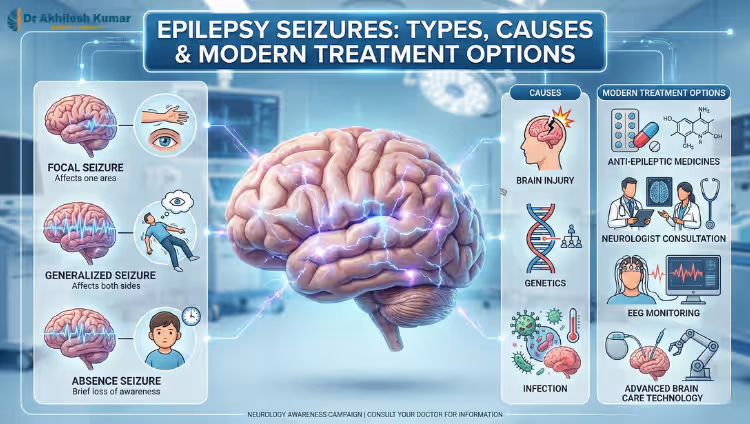
Common causes include a previous head injury, stroke, brain tumor, brain infection like meningitis, or a problem present from birth. Genetics also plays a role in many cases.
But here’s what most articles don’t tell you: sometimes the cause is a tiny abnormality in the brain — so small that a regular MRI scan misses it. You need a special high-resolution MRI to find it. If the cause is missed, treatment fails.
Also, things like poor sleep, stress, missed meals, and hormonal changes don’t cause epilepsy — but they can trigger seizures in someone who already has it.
Chart: Types of Epilepsy Symptoms at a Glance
| Symptom | What It Looks Like | Often Mistaken For | Who It Affects Most |
|---|---|---|---|
| Tonic-clonic seizure | Body stiffens, then shakes | Nothing — very visible | Any age |
| Absence seizure | Blank staring, unresponsive for seconds | Daydreaming, inattention | Children |
| Myoclonic jerk | Sudden arm/shoulder jerk | Clumsiness, caffeine | Teenagers, young adults |
| Focal aware seizure | Strange feeling, déjà vu, smell, fear | Anxiety, panic attack | Adults |
| Focal impaired seizure | Confusion, lip smacking, hand movements | Psychiatric episode | Adults |
| Atonic seizure | Sudden fall, no warning | Fainting, clumsiness | Children |
| Aura only | Rising feeling in the stomach, fear, strange smell | Stress, migraine | Any age |
What Happens If Epilepsy Is Not Treated?
Untreated or poorly managed epilepsy is not just about seizures. Over time it can cause memory problems, difficulty concentrating, trouble at school or work, risk of injury from falls, social isolation, and in rare serious cases, a condition called SUDEP — Sudden Unexpected Death in Epilepsy.
The longer seizures continue without control, the harder the brain becomes to treat. Early action genuinely changes outcomes.
How Is Epilepsy Treated?
Medicines are the first step. Most people with epilepsy can control their symptoms with the right anti-seizure medication. The key word is right — because different seizure types need different medicines. A wrong match can actually make seizures worse.
Surgery is an option that is not discussed enough. If two medicines have failed to control seizures, surgery may work very well — especially when there’s a clear, small area in the brain causing the problem. The earlier it’s done, the better the result.
Nerve stimulation devices like VNS (Vagus Nerve Stimulation) are used when surgery is not possible. They reduce seizure frequency using mild electrical pulses.
Ketogenic diet — a special high-fat, low-carb diet — helps some children when medicines don’t work. It requires strict medical supervision.
When Should You See a Doctor Immediately?
See a doctor the same day if a seizure lasts more than 5 minutes, if the person doesn’t wake up after a seizure, if seizures happen one after another, if the person is injured during a seizure, or if it’s a first-ever seizure.
Don’t wait. Don’t assume it will go away on its own.
8 Frequently Asked Questions About Epilepsy Symptoms
1. Can epilepsy symptoms look like anxiety or a panic attack?
Yes. Focal seizures are very commonly mistaken for anxiety, panic attacks, or even psychiatric episodes. If someone has repeated episodes of sudden fear, strange feelings, or confusion that come and go quickly, epilepsy should be ruled out with a proper EEG test.
2. Can a child have epilepsy without falling or shaking?
Absolutely. Absence seizures in children look like brief staring spells. The child may seem like they’re daydreaming. Teachers and parents often miss this for months or years. If your child seems to “zone out” frequently, get them evaluated.
3. Is epilepsy a lifelong condition?
Not always. Some children outgrow epilepsy. Many adults with well-controlled epilepsy can eventually reduce or stop medication under doctor supervision. But this decision should never be made on your own.
4. What triggers epilepsy symptoms even when on medication?
Common triggers include missed doses, poor sleep, alcohol, stress, hormonal changes, and illness with fever. Identifying personal triggers helps prevent breakthrough seizures.
5. How is epilepsy diagnosed?
The main tests are EEG (which records brain electrical activity) and MRI (which checks brain structure). In unclear cases, a video EEG — where the patient is monitored for days in hospital — is needed to catch a seizure on camera and confirm the diagnosis.
6. Can epilepsy be confused with something else?
Yes, and this happens more often than expected. Up to 20–30% of people diagnosed with epilepsy may actually have a different condition — like a heart problem causing fainting, non-epileptic attack disorder (NEAD), or complex migraine. Misdiagnosis leads to wrong treatment for years.
7. Is epilepsy surgery safe?
When done by an experienced neurosurgeon at the right time, epilepsy surgery has good outcomes. In carefully selected patients with focal epilepsy, surgery can significantly reduce or even eliminate seizures. The key is proper evaluation and choosing the right specialist.
8. Can someone with epilepsy live a normal life?
Yes — with proper treatment and support, most people with epilepsy live full, independent lives. Driving restrictions may apply depending on seizure control. Open communication with your doctor about lifestyle, work, and family planning makes a big difference.
The Most Important Thing Most Doctors Don’t Say Out Loud
If two medicines have not controlled your epilepsy symptoms, don’t just keep trying a third or fourth medicine blindly.
Ask for a full re-evaluation. Ask whether surgery is possible. Ask about advanced treatment options.
The longer you wait, the narrower the window of opportunity becomes.
Consult a Brain Specialist in Lucknow
If you or someone in your family is experiencing epilepsy symptoms — repeated seizures, unexplained blackouts, staring episodes, or uncontrolled convulsions — don’t delay getting expert help.
Dr. Akhilesh Kumar — Brain Surgeon, Lucknow
Dr. Akhilesh Kumar is an experienced neurosurgeon based in Lucknow who specializes in the diagnosis and surgical treatment of neurological conditions, including epilepsy. Whether you need a second opinion, advanced epilepsy evaluation, or are considering surgery, Dr Kumar’s team can guide you at every step.
Don’t manage seizures alone. Expert care changes outcomes.
Book your consultation with Dr Akhilesh Kumar today and take the first step toward real seizure control.
