
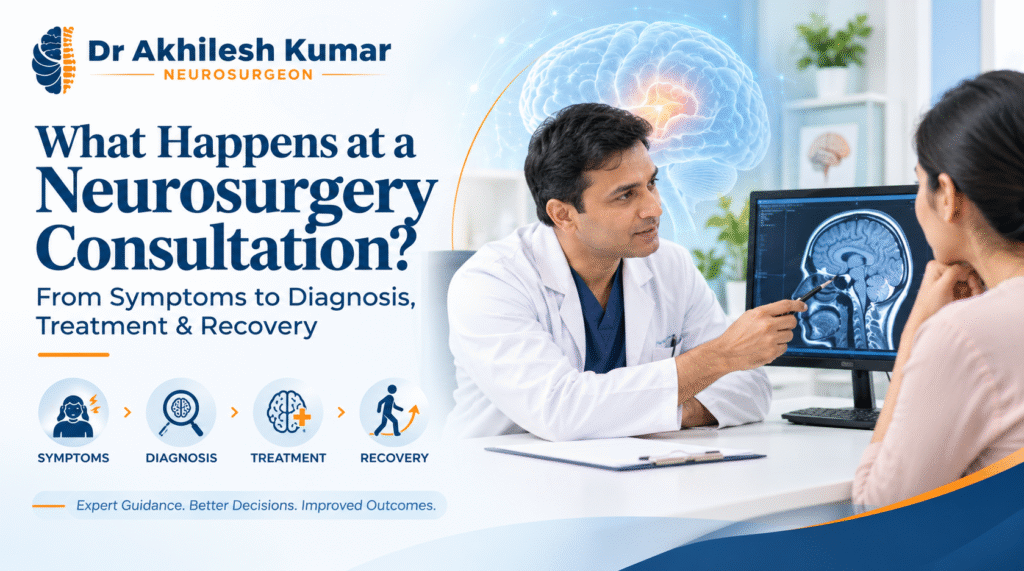
When patients hear the word “neurosurgery,” many immediately think of brain or spine surgery. But a neurosurgical consultation does not automatically mean that surgery is required.
In reality, the first consultation is about understanding the patient’s symptoms, reviewing medical history, performing a neurological examination, evaluating scans or investigations when available, identifying the likely cause and deciding whether treatment should involve observation, medicines, physiotherapy, further testing, minimally invasive treatment or surgery.
This step-by-step approach is particularly important for conditions involving the brain, spinal cord, nerves and spine, where symptoms can sometimes overlap.
For patients searching online for the best neurosurgeon in Lucknow or even the best neurology doctor in India, the more important question is often: What type of specialist do I actually need, and what should happen during the consultation?
This guide explains the process in simple language.
Quick Answer: What Happens During a Neurosurgery Consultation?
A typical neurosurgical consultation may include:
- Discussion of your symptoms
- Review of previous medical records
- Neurological and physical examination
- Review of MRI, CT or other investigations when available
- Identification of the likely problem
- Discussion of treatment options
- Explanation of whether surgery is necessary
- Discussion of expected benefits and possible risks
- Recovery and follow-up planning
- Instructions about when urgent medical attention is required
Not every patient needs surgery. Depending on the condition, treatment may involve monitoring, medication, physiotherapy, lifestyle measures, rehabilitation or surgery.
What Does a Neurosurgeon Treat?
A neurosurgeon is a specialist involved in the evaluation and treatment of disorders affecting the brain, spinal cord, spine and peripheral nerves.
Depending on the patient’s condition, treatment may be surgical or non-surgical.
Common problems evaluated by neurosurgeons include:
Brain conditions
- Brain tumors
- Hydrocephalus
- Head and brain injuries
- Certain vascular or stroke-related conditions
- Seizure disorders requiring surgical evaluation
- Congenital brain conditions
- Conditions causing pressure on or structural problems within the brain
Spine conditions
- Slipped or herniated discs
- Cervical spondylosis
- Lumbar spondylosis
- Spondylolisthesis
- Spinal tumors
- Spinal trauma
- Nerve compression
- Selected spinal deformities
- Tuberculosis of the spine
- Conditions requiring minimally invasive or endoscopic spine procedures
The American Association of Neurological Surgeons also provides patient information covering brain conditions, spine conditions, tumors, stroke, injuries, pediatric problems and other neurosurgical disorders.
When Should You Consider a Neurosurgical Consultation?
Not every headache or backache requires a neurosurgeon.
However, medical evaluation becomes more important when symptoms are persistent, progressive, severe, associated with neurological changes, or accompanied by an abnormal scan or known neurological condition.
Examples include:
- Persistent or unusual headaches
- Recurrent seizures
- Weakness in an arm or leg
- Numbness or tingling
- Difficulty walking or maintaining balance
- Persistent neck or back pain with neurological symptoms
- Pain radiating into an arm or leg
- Loss of bladder or bowel control with spinal symptoms
- Symptoms following significant head or spinal trauma
- A diagnosed brain or spinal tumor
- Hydrocephalus
- Progressive neurological changes
- An MRI or CT scan showing a potentially significant abnormality
The exact cause cannot be determined from symptoms alone, which is why clinical examination and appropriate investigations matter.
Step 1: The Doctor Understands Your Symptoms
The consultation usually begins with a detailed conversation.
You may be asked:
- When did the problem begin?
- Did it start suddenly or gradually?
- Is the symptom getting worse?
- Where exactly is the pain?
- Does pain travel into the arm or leg?
- Have you experienced weakness or numbness?
- Have you had seizures?
- Have you experienced vomiting, confusion or changes in vision?
- Have you had a previous injury?
- Have you already undergone MRI or CT imaging?
- What medications or treatments have you already tried?
Why is this important?
Two patients can have similar symptoms but completely different underlying causes.
For example, back pain can result from muscular problems, degenerative changes, disc disease, nerve compression or other spinal conditions.
Therefore, treatment should be based on the individual diagnosis, not simply the symptom.
Step 2: Medical History and Previous Reports Are Reviewed
If you have already consulted another doctor, bring your previous:
- MRI reports
- CT reports
- X-rays
- Blood investigations
- Prescription records
- Previous discharge summaries
- Operation reports
- Physiotherapy records
If actual scan images are available, they can also be useful in addition to the written report.
Patient tip
Don’t bring only the latest report if you have a history of treatment.
A comparison between older and newer imaging may sometimes provide useful information about how a condition has changed over time.
Step 3: A Neurological Examination Is Performed
A neurosurgical consultation is not based only on an MRI.
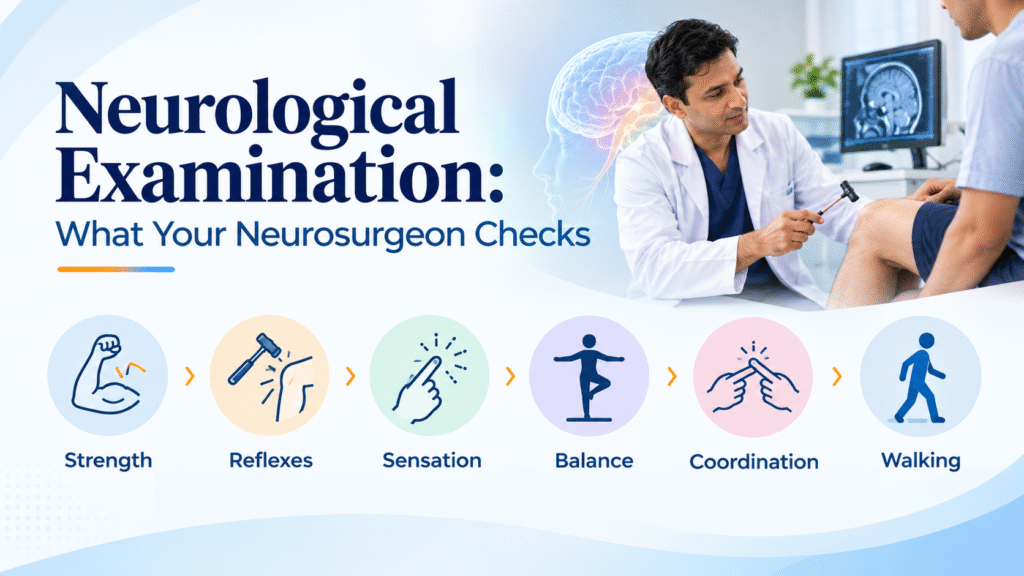
The doctor may assess:
- Muscle strength
- Reflexes
- Sensation
- Coordination
- Walking pattern
- Balance
- Eye movements
- Speech
- Cranial nerve function
- Signs of nerve compression
- Spine movement
- Other neurological findings relevant to the symptoms
This helps connect the patient’s symptoms with the findings on examination and imaging.
Step 4: Do You Need an MRI or CT Scan?
Not every patient needs every scan.
The appropriate investigation depends on the symptoms, clinical examination and suspected condition.
MRI
MRI is commonly used when detailed imaging of the brain, spinal cord, discs, nerves or other soft tissues is required.
It can be particularly useful in evaluating many brain and spine conditions.
CT Scan
CT can provide rapid imaging and is especially useful in certain emergency situations, trauma assessment and evaluation of bones and other structures.
X-ray
X-rays can help assess certain bony and alignment-related problems of the spine.
Other tests
Depending on the suspected diagnosis, a doctor may recommend additional investigations.
The important point is:
A scan should answer a clinical question; the scan alone should not determine treatment.
Step 5: The Diagnosis Is Explained in Simple Language
Once the clinical information and investigations have been reviewed, your doctor should explain:
- What the suspected condition is
- Which structure is affected
- Why the symptoms may be occurring
- Whether the condition is stable or progressing
- Whether nerve or spinal cord compression is present
- What treatment options exist
- Whether surgery is actually necessary
A good consultation should give the patient an opportunity to ask questions.
Does Every Neurosurgical Problem Require Surgery?
No.
This is one of the most important things patients should understand.
Depending on the diagnosis, treatment may include:
Conservative treatment
- Medication
- Physiotherapy
- Activity modification
- Lifestyle measures
- Observation
- Rehabilitation
Minimally invasive treatment
Selected conditions may be suitable for minimally invasive or endoscopic procedures.
Surgery
Surgery may be considered when the medical condition and clinical situation indicate that an operation could provide an appropriate benefit.
For spine conditions, surgery may be considered in situations such as significant nerve or spinal cord compression, neurological deterioration, certain structural problems, trauma, tumors or persistent symptoms despite appropriate non-surgical treatment.
The decision is individualized.
Brain Surgery and Spine Surgery Are Not the Same
Although both fall under neurosurgery, brain and spine operations are different.
Brain surgery
Depending on the condition, procedures may involve:
- Tumor surgery
- Hydrocephalus procedures
- Trauma surgery
- Selected vascular procedures
- Other complex intracranial operations
Spine surgery
Procedures may include:
- Disc surgery
- Decompression
- Spinal stabilization
- Instrumentation
- Tumor surgery
- Endoscopic spine procedures
- Minimally invasive spine surgery
The surgical approach depends on the exact diagnosis, anatomy, symptoms, overall health and treatment goals.
What Happens If Surgery Is Recommended?
If surgery is considered, your neurosurgeon should discuss the procedure before you make a decision.
Important topics include:
1. Why is surgery being suggested?
You should understand the medical reason for the operation.
2. What are the alternatives?
Ask whether observation, medication, physiotherapy or another treatment is appropriate.
3. What will the surgery involve?
Ask about:
- Surgical approach
- Approximate duration
- Hospital stay
- Anesthesia
- Whether implants are required
- Expected recovery
4. What are the potential risks?
Every procedure has potential risks. The relevant risks vary significantly depending on the operation and the patient’s condition.
5. What happens after surgery?
Recovery may involve:
- Pain management
- Wound care
- Mobilization
- Physiotherapy
- Medication
- Follow-up visits
- Repeat imaging in selected cases
How to Prepare for Your Neurosurgery Appointment
You can make your consultation more productive by preparing beforehand.
Bring your medical information
Keep your reports and previous prescriptions together.
Make a symptom timeline
Write down:
- When symptoms started
- How often they occur
- What makes them better or worse
- Any new symptoms
- Previous treatments
Make a medication list
Include prescription medicines, over-the-counter medicines and relevant supplements.
Write your questions
For example:
- What is causing my symptoms?
- Do I need further testing?
- Is surgery necessary?
- What non-surgical options are available?
- What happens if I delay treatment?
- What is the expected recovery period?
- When can I return to normal activities?
When Is a Brain or Spine Problem an Emergency?
Some neurological symptoms require urgent medical assessment rather than waiting for a routine appointment.
For example, stroke symptoms can include sudden weakness or numbness-especially on one side—confusion, difficulty speaking, vision problems, difficulty walking, dizziness, severe unexplained headache or loss of consciousness. WHO guidance advises seeking immediate medical care when these symptoms occur.
Similarly, serious spinal cord injuries can cause weakness, sensory changes, paralysis, walking problems and loss of bladder or bowel control.
Seek emergency medical attention for symptoms such as:
- Sudden facial drooping
- Sudden arm or leg weakness
- Sudden difficulty speaking
- Sudden loss of consciousness
- A seizure that requires emergency assessment
- Severe neurological deterioration
- Serious head injury
- New paralysis
- Rapidly worsening weakness
- New loss of bladder or bowel control associated with spinal symptoms
Do not wait for a routine consultation when symptoms may represent a medical emergency.
How Do You Choose the Right Neurosurgeon?
Patients searching for the best neurosurgeon in Lucknow should look beyond a single online ranking or advertising claim.
Consider objective information such as:
Specialized training
Look for appropriate postgraduate and specialty training in neurosurgery.
Relevant experience
Experience should be relevant to the condition being treated.
Hospital affiliation
Consider where the doctor practices and whether the hospital has appropriate diagnostic, surgical, anesthesia, emergency and critical-care facilities.
Treatment philosophy
A consultation should include discussion of appropriate non-surgical options when applicable rather than assuming every problem requires an operation.
Communication
Patients should be able to understand their diagnosis, treatment options, potential risks and expected recovery.
Evidence-based care
Treatment recommendations should be based on the patient’s clinical findings and established medical principles.
Dr. Akhilesh Kumar’s website states that he has MS (General Surgery) and MCh (Neurosurgery) training, has more than seven years of experience in advanced brain and spine care, and currently practices as a Consultant Neurosurgeon at Apollomedics Super Speciality Hospital, Lucknow.
What About Someone Searching for the “Best Neurology Doctor in India”?
This phrase is frequently used in online searches, but patients should first understand the distinction between neurology and neurosurgery.
A neurologist primarily diagnoses and manages neurological disorders using non-surgical approaches, while a neurosurgeon specializes in conditions where surgical or procedural treatment may be required, while also evaluating and managing many patients who do not ultimately need surgery.
The appropriate specialist depends on the patient’s symptoms and diagnosis.
For example:
| Situation | Specialist evaluation that may be relevant |
| Recurrent migraine | Neurologist may be appropriate |
| Epilepsy | Neurologist; neurosurgical assessment in selected cases |
| Persistent back pain | Neurologist/orthopedic/spine/neurosurgical evaluation depending on cause |
| Herniated disc with nerve compression | Spine/neurosurgical evaluation may be appropriate |
| Brain tumor | Neurosurgical evaluation |
| Hydrocephalus | Neurosurgical evaluation |
| Stroke symptoms | Emergency medical evaluation immediately |
| Spinal cord compression | Urgent specialist assessment |
So, rather than choosing a doctor only because a website says “best neurology doctor in India,” patients should match the specialist’s expertise to their actual medical problem.
Dr. Akhilesh Kumar: Brain & Spine Care in Lucknow
Dr. Akhilesh Kumar is a Consultant Neurosurgeon practicing in Lucknow. His stated areas of expertise include brain and spine trauma, micro-neurosurgical techniques, tumor surgery and spinal instrumentation. His website also describes services covering brain tumors, hydrocephalus, stroke-related care, epilepsy, migraine and multiple spine conditions.
His practice emphasizes evaluation before treatment and states that not every patient requires surgery; treatment may involve medication, physiotherapy, counselling or other non-surgical approaches where appropriate.
Questions to Ask Before Choosing Treatment
Before agreeing to a major procedure, patients may want to ask:
- What exactly is my diagnosis?
- What is causing my symptoms?
- Do I need surgery?
- What happens if I choose observation or conservative treatment?
- Are there minimally invasive options?
- What are the expected benefits?
- What are the possible complications?
- How long will recovery take?
- Will I need physiotherapy?
- When should I return for follow-up?
These questions can help patients participate more meaningfully in treatment decisions.
Why Early Evaluation Can Matter
The importance of early evaluation depends strongly on the condition.
For some problems, monitoring may be appropriate.
For others, delayed assessment may allow neurological deficits to progress.
This is especially relevant when symptoms involve:
- Progressive weakness
- Loss of sensation
- Walking difficulty
- Spinal cord compression
- Severe trauma
- Suspected brain tumor
- Hydrocephalus
- Acute stroke symptoms
For example, spinal cord injury can result in changes in sensation, movement and body function, and severe injuries can produce paralysis or other serious complications.
The key message is therefore not “every symptom requires urgent surgery.”
It is:
Persistent, progressive or sudden neurological symptoms deserve the right medical assessment at the right time.
The Neurosurgery Consultation Is About More Than Surgery
A neurosurgical consultation is a process of answering several questions:
What is causing the problem?
↓
How serious is it?
↓
Does it require treatment now?
↓
Can it be treated without surgery?
↓
If surgery is required, which procedure is appropriate?
↓
What should the patient expect during recovery?
This patient-first approach helps avoid two common mistakes:
Ignoring significant neurological symptoms
and
assuming that every brain or spine problem requires an operation.
Frequently Asked Questions
When should I see a neurosurgeon?
Consider specialist evaluation for persistent or progressive neurological symptoms, significant nerve or spinal cord problems, brain or spine tumors, certain traumatic injuries, hydrocephalus, or conditions for which surgery may be required.
Does seeing a neurosurgeon mean I need surgery?
No. A neurosurgical consultation is an evaluation. Depending on the diagnosis, treatment may be non-surgical, minimally invasive, surgical or simply monitored.
What should I bring to my neurosurgery appointment?
Bring previous MRI/CT scans and reports, prescriptions, discharge summaries, blood-test reports, previous treatment details and a list of current medications.
Is MRI always necessary before seeing a neurosurgeon?
No. The appropriate investigation depends on the symptoms and clinical examination. Your doctor can determine which tests are appropriate.
How do I find the best neurosurgeon in Lucknow?
Look at specialist training, relevant clinical experience, hospital facilities, treatment approach, communication and whether the doctor evaluates both surgical and non-surgical options appropriately.
Who is the best neurology doctor in India?
There is no single objective answer that applies to every patient. The appropriate specialist depends on the neurological condition, required treatment and the doctor’s relevant expertise. Patients should distinguish between neurologists and neurosurgeons when selecting care.
Can a spine problem be treated without surgery?
Yes. Depending on the diagnosis, treatment can include medication, physiotherapy, activity modification, rehabilitation and observation. Surgery is considered when clinically appropriate.
When is a neurological problem an emergency?
Sudden weakness, facial drooping, speech difficulty, loss of consciousness, severe neurological deterioration, serious head injury, sudden paralysis or other acute neurological changes can require emergency assessment.
Final Takeaway
A neurosurgery consultation is not simply a decision about whether to operate.
It is a structured process:
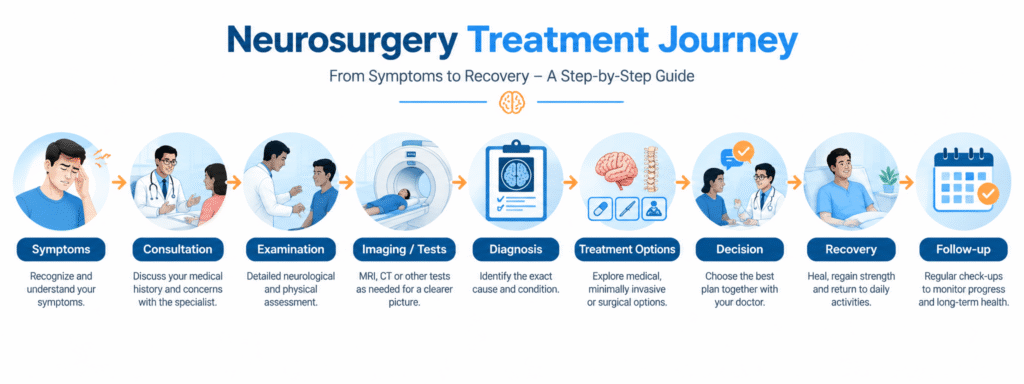
Symptoms → Medical history → Neurological examination → Appropriate investigations → Diagnosis → Treatment options → Shared decision-making → Recovery and follow-up
Whether you are dealing with a brain condition, spine problem, nerve compression, tumor, trauma or another neurological concern, getting the correct diagnosis is the first step toward choosing an appropriate treatment pathway.
For patients in Lucknow looking for a neurosurgeon for brain and spine conditions, Dr. Akhilesh Kumar provides consultation and treatment for a broad range of neurological and neurosurgical conditions, with his practice based at Apollomedics Super Speciality Hospital, Lucknow.
If you have sudden neurological symptoms such as facial drooping, one-sided weakness, speech difficulty or loss of consciousness, seek emergency medical care immediately rather than waiting for a routine appointment.
