
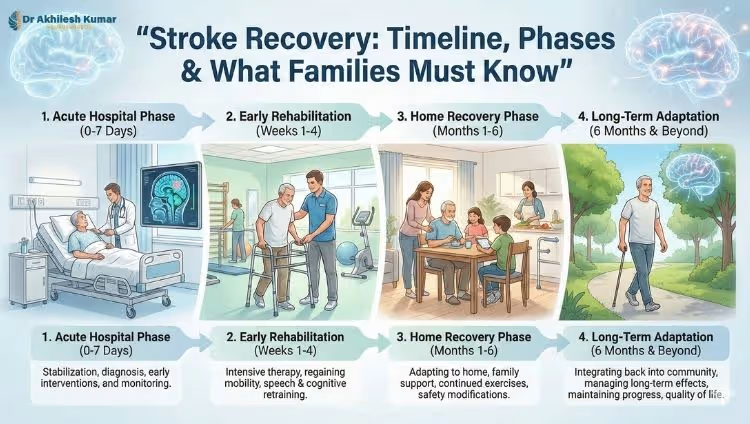
Stroke Recovery: What Really Happens
Posted By Dr Akhilesh Kumar | Neurosurgeon in Lucknow
Most articles about stroke recovery follow a basic pattern — hospital, rehab, 90 days, lifestyle changes. That’s not wrong, but it leaves out a lot of important things.
Recovery after a stroke involves brain repair, psychology, family support, and finances all at once. If any one of these breaks down, progress slows.
The First Week
The first few days are the most critical. The brain is swollen and inflamed. If it was a bleeding stroke, there’s a risk of more bleeding. If it was a clot-based stroke, the clot can grow. Decisions made in these first 72 hours have a huge impact on long-term recovery. Delays in treatment, poor blood pressure control, or lying still too long can all cause serious problems down the line.
Weeks 1 to 3 Months
This is the period doctors focus on most. The brain is trying to rewire itself, finding new pathways to replace damaged ones. But recovery doesn’t happen automatically just because therapy starts. It depends on where and how big the stroke was, the patient’s age, other health conditions like diabetes or high blood pressure, how intense the therapy is, sleep, nutrition, mood, and family support. Miss any of these and recovery slows down.
3 to 6 Months — The Plateau
People often hear that most recovery happens in the first three months. This is mostly true, but it creates a dangerous belief — that if you’re not better by then, you never will be. That’s not accurate. The brain’s ability to adapt slows down after three months, but it doesn’t stop. Progress after this point is less automatic. It requires deliberate, structured effort. Without that structure, patients can actually go backward.
6 Months and Beyond
This is where real life continues, and where most articles stop giving useful information. Long-term, many stroke survivors deal with chronic tiredness, emotional changes, difficulty concentrating, small memory problems, and personality shifts that put strain on relationships. These things don’t show up on discharge papers but they deeply affect quality of life.
When Recovery Fails
Recovery can quietly fall apart when muscle stiffness is ignored, depression goes untreated, small strokes keep happening, or therapy stops too early. A patient might regain the ability to walk, stop going to therapy, slowly develop stiffness, and then lose that ability a year later. Nobody talks about this maintenance gap.
The Hidden Cognitive Problems
Physical improvement is easy to see. Mental and cognitive changes are not. Many survivors struggle with thinking more slowly, switching between tasks, making financial decisions, or judging risk properly. Family members often say “he looks fine” without realizing the brain’s decision-making circuits are still fragile. This is why returning to work should be a slow and careful process.
The Risk of a Second Stroke
The chance of having another stroke is highest in the first 30 days and the first year. The biggest real-world problem is that people stop taking their medications — because of cost, side effects, or because they feel fine. A second stroke is usually worse and harder to recover from. Prevention is not separate from recovery. It is part of it.
Special Cases
Younger stroke patients may recover faster physically, but the emotional impact is heavier — career disruption, identity loss, and relationship strain. Bleeding strokes and clot-based strokes also behave differently. Same word, different biology, different timelines. Patients with very little movement in the first four weeks have a harder road, but it’s not hopeless — they need intensive positioning, stimulation, and prevention of joint damage. Most families aren’t prepared for how demanding that is.
Lifestyle Changes — The Honest Version
Everyone tells stroke survivors to stop smoking, exercise, eat well, and control blood pressure. What actually determines whether people follow through is cultural habits, family routines, financial stability, emotional support, and access to follow-up care. Without systems in place, lifestyle advice rarely sticks.
What Families Should Actually Ask
Instead of asking how long recovery will take, families should ask more useful questions — how big was the stroke and where did it happen, was blood flow restored in time, what complications have appeared, is there any movement returning by week four, is the therapy frequent and intense enough, are medications being taken every day, has the patient’s mood been checked, and is fatigue getting in the way of therapy.
The Three Things That Must Be Maintained Long-Term
The first is neurological stability — controlling blood pressure, blood sugar, and taking medications consistently. The second is physical strength — continuing physiotherapy, resistance exercises, and balance training even at home. The third is mental conditioning — structured daily routines, memory exercises, and gradually taking on more responsibilities. If any of these three weakens, the risk of going backward increases.
Warning Signs That Need Immediate Attention
New weakness, sudden speech problems, increased confusion, a severe headache in someone who had a bleeding stroke, or new seizures are not normal parts of recovery. These can signal a second stroke, fluid buildup in the brain, delayed bleeding, or post-stroke epilepsy. Acting fast in these moments can prevent months of progress from being undone.
Stroke Recovery at a Glance — Phase by Phase
| Phase | Time Period | What Happens in the Brain | Key Focus |
|---|---|---|---|
| Hyperacute | Day 0–3 | Swelling, inflammation, risk of expansion | Survival, emergency treatment |
| Acute | Day 3–7 | Damage becomes clearer, complications possible | Stabilization, prevent complications |
| Early Recovery | Week 1–Month 3 | Brain actively rewiring, plasticity at its highest | Intensive therapy, nutrition, sleep, mood |
| Plateau Phase | Month 3–6 | Plasticity slows but does not stop | Structured effort, compensatory strategies |
| Long-Term Adaptation | Month 6–Years | Fatigue, cognitive changes, emotional shifts emerge | Maintenance, lifestyle, prevention of regression |
| Lifelong Maintenance | Ongoing | Risk of second stroke remains | Medications, BP control, therapy continuation |
This table shows why stroke recovery cannot be judged at a single point in time. Each phase has its own biology, its own risks, and its own requirements. Missing what one phase demands makes the next phase harder.
The Bottom Line
Stroke recovery timelines are averages. Individual patients are not averages. Some people walk within weeks. Others take years. Some never regain full independence. What matters is not how fast recovery happens, but whether there is a steady, consistent direction forward. The brain rewards structure and punishes inconsistency. Recovery is not a 90-day event. It is a long, ongoing process of working with a changed nervous system. The sooner families understand this, the better the outcome tends to be.
Frequently Asked Questions
1. How long does stroke recovery actually take?
There is no single answer. Most visible physical improvement happens in the first three months because the brain is most actively rewiring during this time. But recovery — especially cognitive and emotional recovery — can continue for years. The real question is not how long it takes, but whether the right systems are in place to support it at every stage.
2. Is it normal to feel more tired than before the stroke, even months later?
Yes, and this is one of the most underreported problems after stroke. Post-stroke fatigue is a real neurological condition, not just laziness or low mood. The brain is working much harder than before to do ordinary tasks, which drains energy faster. It does not always improve on its own and should be discussed with a neurologist or neurosurgeon so it can be properly managed.
3. My family member had a stroke three months ago and progress seems to have stopped. Is recovery over?
No. The plateau that many patients hit around three months feels discouraging, but it does not mean recovery is finished. What changes is that the brain no longer rewires automatically — progress now requires more deliberate and structured effort. Continuing therapy, maintaining routines, and controlling risk factors like blood pressure can still produce meaningful improvement well beyond this point.
4. How do we know if a new symptom is part of recovery or something more serious?
Any sudden new weakness, sudden change in speech, new confusion, a severe headache, or new seizures should never be assumed to be a normal part of recovery. These are red flag symptoms that may indicate a second stroke or another serious complication. The patient should be taken to a hospital immediately. When in doubt, always get evaluated — delay in these situations can undo months of hard-won progress.
5. Can someone who had a stroke return to a normal life?
Many stroke survivors do return to meaningful, active, and fulfilling lives — but “normal” often looks different from before. The goal of recovery is not to go back to exactly who you were, but to build a new, stable baseline. With the right medical support, consistent therapy, medication adherence, and family involvement, a large number of patients regain independence and quality of life. Early and expert neurological guidance makes a significant difference in how far recovery can go.
Consult Dr. Akhilesh Kumar — Neurosurgeon in Lucknow
Stroke recovery is not something families should navigate alone or with guesswork.
If your loved one has had a stroke and you are unsure about the next step — whether it is understanding the damage, planning rehabilitation, managing complications, or preventing a second stroke — expert neurological guidance matters more than most people realize.
Dr. Akhilesh Kumar is a neurosurgeon based in Lucknow with deep experience in managing complex brain conditions including stroke, brain tumors, and neurological emergencies. He works with patients and families to create structured, realistic recovery plans — not just for the first 90 days, but for the long road beyond.
If you are in Lucknow or nearby and are looking for clear, expert guidance on stroke recovery, do not wait for symptoms to worsen or progress to stall.
Book a consultation with Dr. Akhilesh Kumar today. Early expert involvement is one of the most important decisions a family can make after a stroke.
